
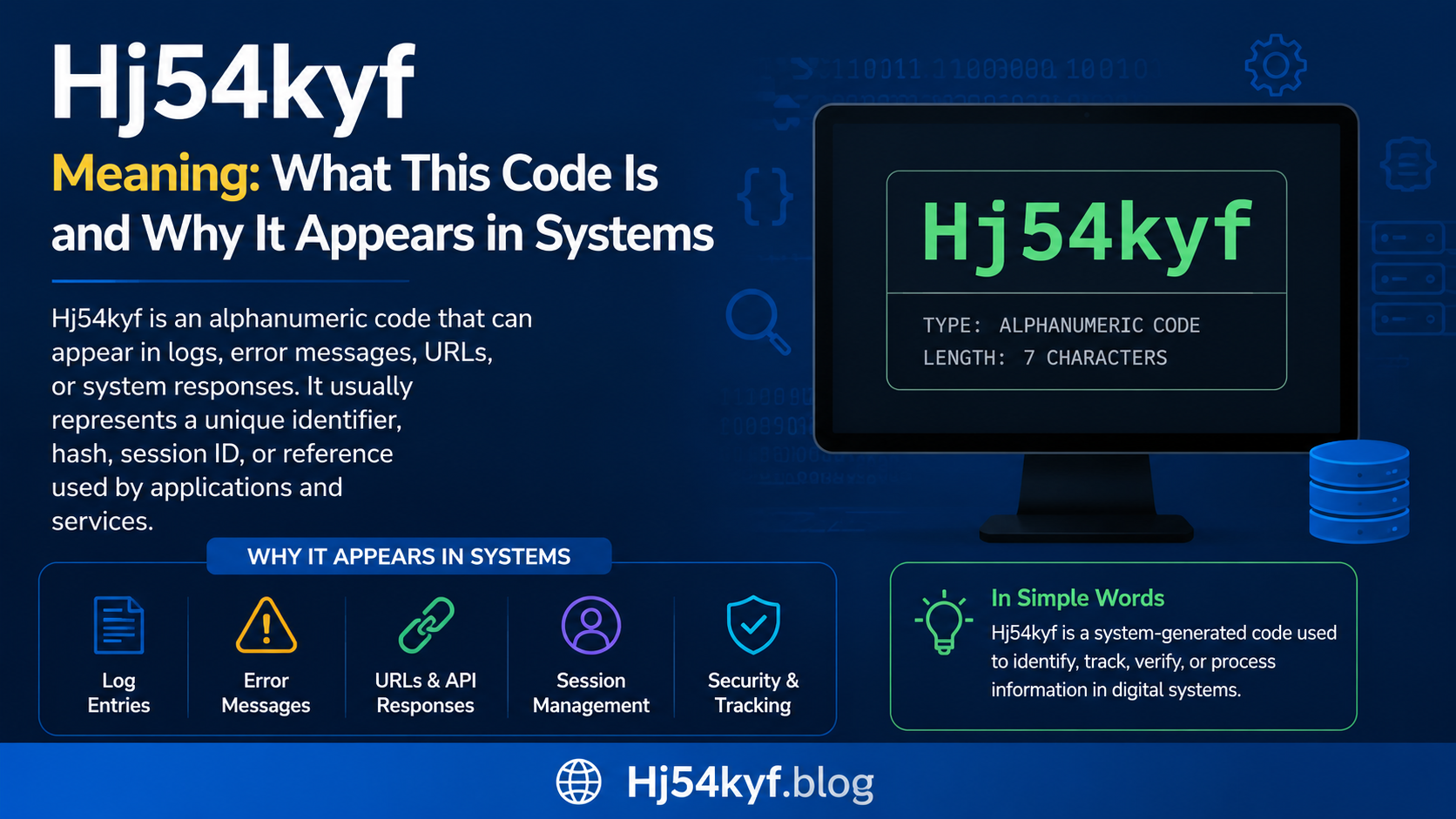
The term hj54kyf may look confusing at first glance. It appears as a random mix of letters and numbers, often showing up in emails, receipts, system logs, or website pages. Many users assume it has a hidden meaning, but in most cases, it is simply a system-generated identifier used by digital platforms.
In today’s digital environment, almost every online action creates some form of reference code. These codes help systems stay organized, especially when handling millions of users, transactions, or data entries. The code hj54kyf is one example of such an identifier.
Why People Search for It Online
When users encounter hj54kyf, they often search for its meaning because it feels unfamiliar and technical. It does not resemble a normal word, which leads to confusion or concern. However, understanding its role in digital systems helps remove that uncertainty.
In most cases, hj54kyf is not something users need to interact with directly. It simply exists in the background to help systems track and manage information efficiently.
What Does hj54kyf Actually Mean?
A System-Generated Identifier Explained
The keyword hj54kyf does not have a dictionary definition or linguistic meaning. Instead, it belongs to a category of alphanumeric identifiers created by software systems. These identifiers are designed to be unique and machine-readable rather than human-friendly.
Such codes are commonly used in databases, APIs, and automated systems where unique identification is required . hj54kyf is simply one of countless combinations that could be generated to represent a specific record or event.
Why It Has No Human Meaning
Unlike words in natural language, hj54kyf is not meant to communicate ideas or concepts. It is created using algorithms that combine random letters and numbers to ensure uniqueness. This prevents duplication in large systems.
The meaning of hj54kyf only exists within the system that generated it. Outside of that context, it holds no inherent definition, making it purely functional rather than descriptive.
Why hj54kyf Appears in Systems and Platforms

Modern digital platforms rely heavily on backend systems to manage data. Every time a user performs an action—such as placing an order, logging in, or submitting a form—the system generates a unique identifier . hj54kyf is an example of such an identifier.
These identifiers help systems organize and retrieve information quickly. Without them, managing large amounts of data would become inefficient and error-prone.
Key Functional Roles of Alphanumeric Identifiers
- Unique Identification: It acts as a unique ID to identify users, devices, sessions, or transactions across systems.
- Tracking and Logging: It helps platforms track activities, logs, and events for monitoring and troubleshooting.
- Security and Verification: Used in authentication, authorization, and security checks to prevent fraud and unauthorized access.
- System Integration: Enables smooth communication and integration between different systems and applications.
- Performance Optimization: Helps in caching, indexing, and efficient data retrieval for better performance and scalability.
Importance of Uniqueness in Digital Environments
One of the main reasons codes like hj54kyf exist is to ensure uniqueness. In large databases, even a small duplication could cause serious errors. Randomized alphanumeric strings reduce this risk significantly.
By generating unique identifiers, systems can track millions of entries without confusion, ensuring smooth operation across platforms and services.
Technical Deep Dive: Developer Consoles and Debugging Logs
For web developers, software engineers, and IT administrators, strings like hj54kyf are part of daily infrastructure management. When debugging an application, these short alphanumeric sequences serve as crucial anchor points within system consoles.
Tracing Identifiers in the Browser Console
When an application encounters an error or processes a request, developers often inspect the network tab or console logs using browser developer tools (F12). A code like hj54kyf might appear in a console entry like this:
Plaintext
[2026-06-14 00:22:15] SECURE_AUTH_SUCCESS: Session tracking initialized with token [hj54kyf]
[2026-06-14 00:22:17] ERROR: Failed to fetch API resource. Request Reference ID: hj54kyf
When a user reports an issue along with this reference code, developers can query their backend logging systems (such as Splunk, Datadog, or ELK Stack) using hj54kyf to isolate the exact transaction or server thread that caused the failure, bypassing thousands of lines of unrelated data logs.
How hj54kyf Is Generated by Digital Systems
Randomization and Algorithm-Based Creation
The identifier hj54kyf is created using algorithms designed to generate random or semi-random strings. These algorithms may use timestamps, user data, or random number generators as input. The goal is to produce a code that is highly unlikely to repeat, even across millions or billions of records.
Structure of Alphanumeric Codes
System-generated identifiers like hj54kyf typically combine lowercase letters and numbers. This structure increases the number of possible combinations, making it more efficient than using only numbers or only letters. This method ensures scalability in large systems where millions of new records are created every day.
Under the Hood: Low-Level Data Representation
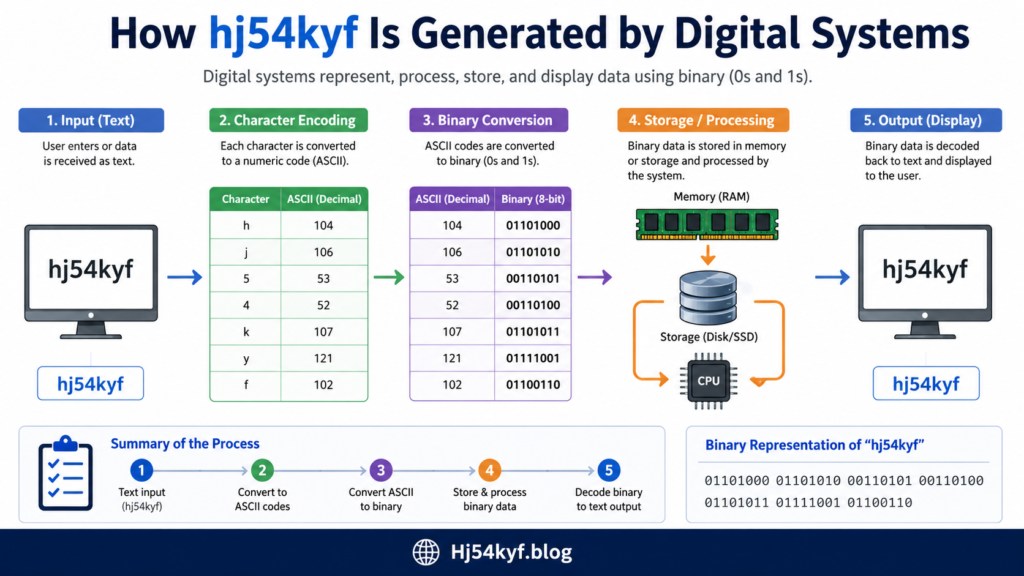
Digital systems represent, process, store, and display data using binary ($0$s and $1$s). When a system processes the text input hj54kyf , each individual character is converted to its corresponding numeric ASCII code , which is then transformed into an 8-bit binary string for hardware processing.
| Character | ASCII (Decimal) | Binary (8-bit) |
| h | $104$ | 01101000 |
| j | $106$ | 01101010 |
| 5 | $53$ | 00110101 |
| 4 | $52$ | 00110100 |
| k | $107$ | 01101011 |
| y | $121$ | 01111001 |
| f | $102$ | 01100110 |
Hence, at the central processing unit (CPU) and memory level, the code hj54kyf is processed entirely as a sequence of binary digits: 01101000 01101010 00110101 00110100 01101011 01111001 01100110.
Common Places Where You Might See hj54kyf
Emails, Receipts, and Confirmations
One of the most common places users encounter hj54kyf is in confirmation emails or digital receipts. It may appear as an order number, transaction ID, or reference code used for tracking purposes. These identifiers help customer support teams quickly locate specific records when users request assistance.
Apps, Websites, and System Logs
You may also see hj54kyf in app notifications, website URLs, or backend logs. Developers use these codes to debug issues, track user activity, or monitor system performance. In analytics systems, similar identifiers help link actions to specific sessions or events without exposing personal data.
Is hj54kyf a Virus, Scam, or Something Harmful?
Understanding Common Misconceptions
Many users worry when they see random codes like hj54kyf, thinking they might be linked to malware or scams. In reality, these identifiers are harmless and are widely used in legitimate systems. They are not executable files, links, or programs; instead, they are simple text strings generated for tracking and organization.
When Caution Is Needed
Although hj54kyf itself is not harmful, context matters. If you receive it in a suspicious email or message with unknown links, the concern is not the code but the sender. Always verify the source of any communication. If it comes from a trusted platform, then hj54kyf is simply part of that system’s internal tracking process.
What You Should Do If You Encounter hj54kyf
Identify the Source First
If you come across hj54kyf, the first step is to check where it came from. It could be an email, website, receipt, or application message. Understanding the source helps determine its purpose. If it is linked to a purchase or account, it is likely a reference number used by that platform.
When Action Is Required
In most cases, no action is needed. However, if the code appears in an unfamiliar or suspicious message, avoid clicking any links and verify the sender’s authenticity. If needed, you can provide the code to customer support to help them locate your record.
Future of System-Generated Identifiers
Increasing Use in Digital Ecosystems
As technology continues to grow, identifiers like hj54kyf will become even more common. They are essential for managing complex systems such as cloud computing, AI platforms, and large databases. The demand for unique identifiers will increase as digital interactions continue to expand.
Potential Improvements in User Experience
Future systems may introduce more user-friendly identifiers while still maintaining backend uniqueness. Some platforms may combine human-readable formats with system-generated codes for better usability. Despite these changes, the core concept behind hj54kyf will remain essential to digital infrastructure.
FAQs (Frequently Asked Questions)
What is hj54kyf used for?
It is used as a system-generated identifier to track data, transactions, or records in digital platforms.
Is hj54kyf a real word?
No, it is not a real word. It is a randomly generated alphanumeric code used by digital software systems.
Why do I see hj54kyf in emails or receipts?
It is typically used as a reference code, transaction ID, or tracking number for orders, support tickets, or background system logs.
Can hj54kyf be harmful or a sign of a virus?
No, the code itself is completely harmless text. However, if it appears inside a suspicious email from an unknown sender, use caution with the email contents.
Does hj54kyf mean anything outside its system?
No, it only has functional meaning within the specific system that generated it and has no standalone dictionary definition.
Should I ignore hj54kyf when I see it?
In most cases, yes. It is usually just a background reference identifier and requires no direct interaction or action from the user.
Conclusion
The keyword hj54kyf represents a simple but important part of modern digital systems. While it may look random or confusing, it serves a clear purpose as a system-generated identifier used for tracking, organization, and data management. Understanding how these codes work helps users feel more confident when encountering them online. They are not harmful, not meaningful in human language, and not something to worry about—just a small but essential piece of digital infrastructure.
Disclaimer
The information provided on this website is for general informational and educational purposes only. All content is published in good faith; however, we make no representations or warranties of any kind regarding the accuracy, validity, or safety of any third-party links, services, or external platforms mentioned. Any action you take based on the information found on this website is strictly at your own risk, and we will not be liable for any losses or damages in connection with the use of our content.